How do you write a check with power of attorney?
If you need to sign a check for her, the usual procedure is to write her name on the top line and then add your name and title underneath, Mr. Rubenstein says. For example, you would write your mother's name on the main line. Underneath it, you would write: "By (insert your own name), as attorney in fact."
How do you address a letter to someone who has power of attorney?
The proper way to sign as an agent is to first sign the principal's full legal name, then write the word “by,” and then sign your name. You may also want to show that you are signing as an agent by writing after the signature: Agent, Attorney in Fact, Power of Attorney, or POA.
Can a POA sell a house in Florida?
In Florida you can create the following powers of attorneys: General Power of Attorney: the general power of attorney allows you to give your agent broad authority. Your agent will be able to do financial transactions like banking, buying or selling real estate, deal with the government, among others.
What are Poas?
Key Takeaways. A power of attorney (POA) is a legal document giving one person (the agent or attorney-in-fact) the power to act for another person, the principal. The agent can have broad legal authority or limited authority to make decisions about the principal's property, finances, or medical care.
What is the proper way to address an attorney in an email?
Professional Correspondence. Address an attorney as "Mr." or "Ms." in most contexts. In the salutation for a letter or email, address an attorney the same way you would any other respected professional- using "Mr." or "Ms." followed by their surname.
What is power of attorney in property?
A Power of Attorney (POA) is an authorisation given by a property owner in writing to another person to carry out property-related transactions on their behalf.
What three decisions Cannot be made by a legal power of attorney?
You cannot give an attorney the power to: act in a way or make a decision that you cannot normally do yourself – for example, anything outside the law. consent to a deprivation of liberty being imposed on you, without a court order.
Can I sell my dad's house with power of attorney?
To reiterate, with a power of attorney property can only be sold if the subject is incapable of making a decision - but the sale must be in the subject's interests.
Can a property be sold with power of attorney?
A person given power of attorney over a property cannot sell the asset unless there is a specific provision giving him the power, the Supreme Court has held in a judgment.
Does power of attorney need to be notarized?
Registration of power of attorney is optional In India, where the 'Registration Act, 1908', is in force, the Power of Attorney should be authenticated by a Sub-Registrar only, otherwise it must be properly notarized by the notary especially where in case power to sell land is granted to the agent.
Does power of attorney means ownership of property?
Latest supreme court judgement on power of attorney 2021 “A PoA is not an instrument of transfer in regard to any right, title or interest in an immovable property,” a three-judge bench, headed by justice RV Raveendran, said, adding that property can legally be transferred only through a registered sale deed.
What are the 3 power of attorney?
Generally speaking, there are three main types of POA: Ordinary power of attorney. Lasting power of attorney. Enduring power of attorney.
What is a power of attorney?
A power of attorney is a document that creates a legally binding agreement between two parties — a principal and an attorney-in-fact. A power of attorney form grants an attorney-in-fact the right to: access the principal’s financial accounts. sign legal documents on the principal’s behalf. manage the principal’s legal and business affairs.
How to sign a POA?
Step 1: Bring Your Power of Attorney Agreement and ID. When signing as a POA, you need to bring the original power of attorney form to the meeting — even if you’ve already registered a copy of the document with the institution (such as a bank, financial agency, or a government institution). You also need to bring government-issued photo ...
How to act as an attorney in fact?
access the principal’s financial accounts. sign legal documents on the principal’s behalf. manage the principal’s legal and business affairs. As an attorney-in-fact, you must act in the principal’s best interest, and adhere to their wishes when signing documents for them. This means doing what the principal would want you to do, no matter what.
What is a power of attorney?
A real estate power of attorney can be used to give powers for single or multiple real estate transactions. It is also very useful when needing someone to manage your property. This could include signing lease agreements, buying or selling property, evicting tenants, etc. As an example, a property owner could hire a property management company ...
How many witnesses do you need to sign a power of attorney?
It varies State-by-State the signing requirements. To guarantee the form is acceptable in every State, the principal should have signed with two (2) witnesses and a notary public.
What is the principal's attention in Article III?
Term.” The Principal will only need to initial the statement that he or she wishes applied as a definition of this document’s Period of Effect.
Can a principal choose a form to be indefinite?
If the agent is managing the premises, then the principal would maybe want the term to be indefinite. In addition, if the principal is seeking to have the agent keep their role if the principal should be incapacitated or not able to use cognitive functions, they can select the form to be “durable”.
How to sign a power of attorney?
To sign as a power of attorney, start by signing the principal's full legal name. If you're dealing with a financial account, sign their name the same way it's listed on the account. Next, write the word "by" on the line below the principal's name and sign your own name.
When does a POA go into effect?
Your POA agreement should specify exactly when the POA will go into effect, how long it will last, and what duties and powers the agent has under the agreement. Some POA agreements go into effect when signed, while others are designed to go into effect only when a specified event happens.
What does POA mean?
When someone gives you power of attorney (POA) in the United States, it means you have the authority to access their financial accounts and sign financial or legal documents on their behalf. POA is given using a legal POA document that has been drafted and executed according to your state's law.
What does it mean to be an attorney in fact?
When the document goes into effect, you become that person's attorney in fact, which means you act as their agent. Generally, to sign documents in this capacity, you will sign the principal's name first, then your name with the designation "attorney in fact" or "power of attorney.". Steps.
What happens if you don't check a POA?
This means if you don't check anything, the agent won't have any powers.
What to put after principal name?
Following your name, you need to add a word or phrase that shows how you have the power to legally sign the principal's name for them. Without this, your signature won't be binding. Typically you'll use the phrase "attorney in fact" or "power of attorney.". For example: "Sally Sunshine, by Molly Moon, attorney in fact.".
Who can help with POA?
An attorney who specializes in trusts and estates can assist you if you need a POA for reasons not covered in the basic form. For example, in many states a basic POA document won't allow the agent to act on the principal's behalf in real estate transactions.
When to bring a power of attorney?
Always bring your power of attorney document with you when you transact business on someone else’s behalf and make sure the people you do business with know that you are acting under a power of attorney.
What is a power of attorney?
A power of attorney is a legal document that gives someone the authority to sign documents and conduct transactions on another person’s behalf. A person who holds a power of attorney is sometimes called an attorney-in-fact.
What does it mean when you sign a document as an attorney in fact?
When you sign a document as someone’s attorney-in-fact, your signature needs to make it clear that you—not they—are signing the document and that you are acting under the authority of a power of attorney. To understand how this works, let’s suppose your name is Jill Jones and you have power of attorney to act for your friend, Sam Smith.
What is a person who holds a power of attorney called?
A person who holds a power of attorney is sometimes called an attorney-in-fact. Many people sign a financial power of attorney, known as a durable power of attorney, to give a friend or family member the power to conduct financial transactions for them if they become incapacitated. People also commonly sign health care powers ...
What happens if you sign a document in your own name?
If you sign a document in your own name without indicating that you are acting under a power of attorney, you could be held personally responsible for the transaction. If you sign only the principal’s name, you could face criminal or civil penalties for fraud or forgery.
Why do people sign powers of attorney?
People also commonly sign health care powers of attorney to give someone else the authority to make medical decisions if they are unable to do so. Powers of attorney have other uses as well.
Who is a fiduciary under a power of attorney?
A person who acts under a power of attorney is a fiduciary. A fiduciary is someone who is responsible for managing some or all of another person’s affairs. The fiduciary has a duty to act prudently and in a way that is fair to the person whose affairs he or she is managing. An attorney-in-fact who violates those duties can face criminal charges ...
Real Estate Power of Attorney Forms
The Real Estate Power of Attorney is a convenient option for those who need the assistance of another to carry out a transaction involving real property. This could include assigning someone to perform a purchase or sale on your behalf, managing a particular property, or refinancing a mortgage.
What is a Real Estate Power of Attorney?
A power of attorney agreement essentially conveys authorized rights from one person to another within a written register. This specific POA is designed to cover distributed controls relating to a particular piece of real estate.
How to Use a Real Estate POA Form
When granting powers of attorney for real estate, the first factor to consider is which permissions will be necessary to issue. Bestowed rights can be delegated to cover a wide range of privileges or on a singular basis to meet the property owner’s needs.
How to Revoke Real Estate Powers of Attorney
After a power of attorney has served its purpose, and the instated controls are no longer needed in the eyes of the issuing principal, cancelation of the arrangement can be invoked.
What happens if an owner becomes incompetent before signing a power of attorney?
If an owner becomes incompetent before signing a power of attorney, then only a guardian appointed by the court can act. Obtaining a court order requires the filing of a petition, publication of legal notices, costs money and takes time. Hopefully your seller did some estate planning.
What is a power of attorney?
A power of attorney is a document by which an owner (principal) appoints another person (agent) to act for the owner. It is used when the owner is living but unable to act for himself. Do not confuse the use of the word “agent” with real estate agent.
What are the duties of an agent under a power of attorney?
An agent (s) under a power of attorney or a representative (s) in an estate has certain duties: (1) exercise the powers for the benefit of the principal (owner) (2) keep personal assets separate from those ...
Who must sign the listing contract?
Remember that all of the authorized agents under the power of attorney or representatives in an estate must sign the listing agreement, disclosure documents, etc. For example, when there are two executors in an estate, then they both must sign the Listing Contract.
Can a power of attorney be used when the principal is living?
Another limitation of a power of attorney document is that it may only be used when the principal is living. After, the power of attorney is no longer effective and an estate must be opened with the county court where the principal resided.
Who is appointed by the court to handle the principal's assets including real estate?
A representative is then appointed by the court to handle the principal’s assets including real estate. If a person died with a Will, the representative (s) named in the Will is appointed by the court and referred to as an executor (s). A person who dies without a Will has an administrator (s) appointed by the court.
Who has the power to sell or lease a deceased person's real estate?
A representative (s) has the power to sell or lease the deceased person’s real estate as long as the real estate has not been specifically devised to someone in a Will. Accordingly, it is a good idea to take a look at the Will to make sure the real estate was not given to someone before you list it.
What is a POA in real estate?
A Power of Attorney (POA) is a legal document executed by a Principal (buyer or seller) that designates an agent, referred to in this document as the Attorney in fact, to sign on their behalf. In the State of Maryland, it is suggested that you use a statutory POA form when such a power is needed.
What powers are given to the attorney in fact?
Different powers are given to the attorney in fact, specific to the transaction participant, buyer or seller. If the POA is to be used by the buyer, there should be specific language in the POA that authorizes the attorney in fact to sign all buyer specific documents provided to them by the closing agent. This would include notes, deeds of trust, ...
What should a POA include?
What Should a Power of Attorney Include? The POA should be specific to the property involved. It must set out all names of the parties to the POA, it should state the address of the property and the legal description, if available. Different powers are given to the attorney in fact, specific to the transaction participant, buyer or seller. ...
What is POA power?
By giving someone the power to sign on their behalf, the Principal is giving the attorney-in-fact power to make decisions for them. When signing a POA, the Principal’s signature must be notarized at the time and place it is signed. A local notary in any state of the U.S. is acceptable. If signed in a foreign country, ...
How long does it take to get documents back from closing?
This results in an acceptable delay to the closing, usually one day. Often the closing agent can send documents alternatively by email if preferred.
What is a termination date in a POA?
A termination date is good to limit the use of the document . If in the event the POA you need to use involves any of these issues, it can be reviewed by the closing attorney or the attorney working for ...
Can you use a POA form in Maryland?
In the State of Maryland, it is suggested that you use a statutory POA form when such a power is needed. Mehalko & Moghul can prepare a suitable POA to be used in Virginia and The District of Columbia.
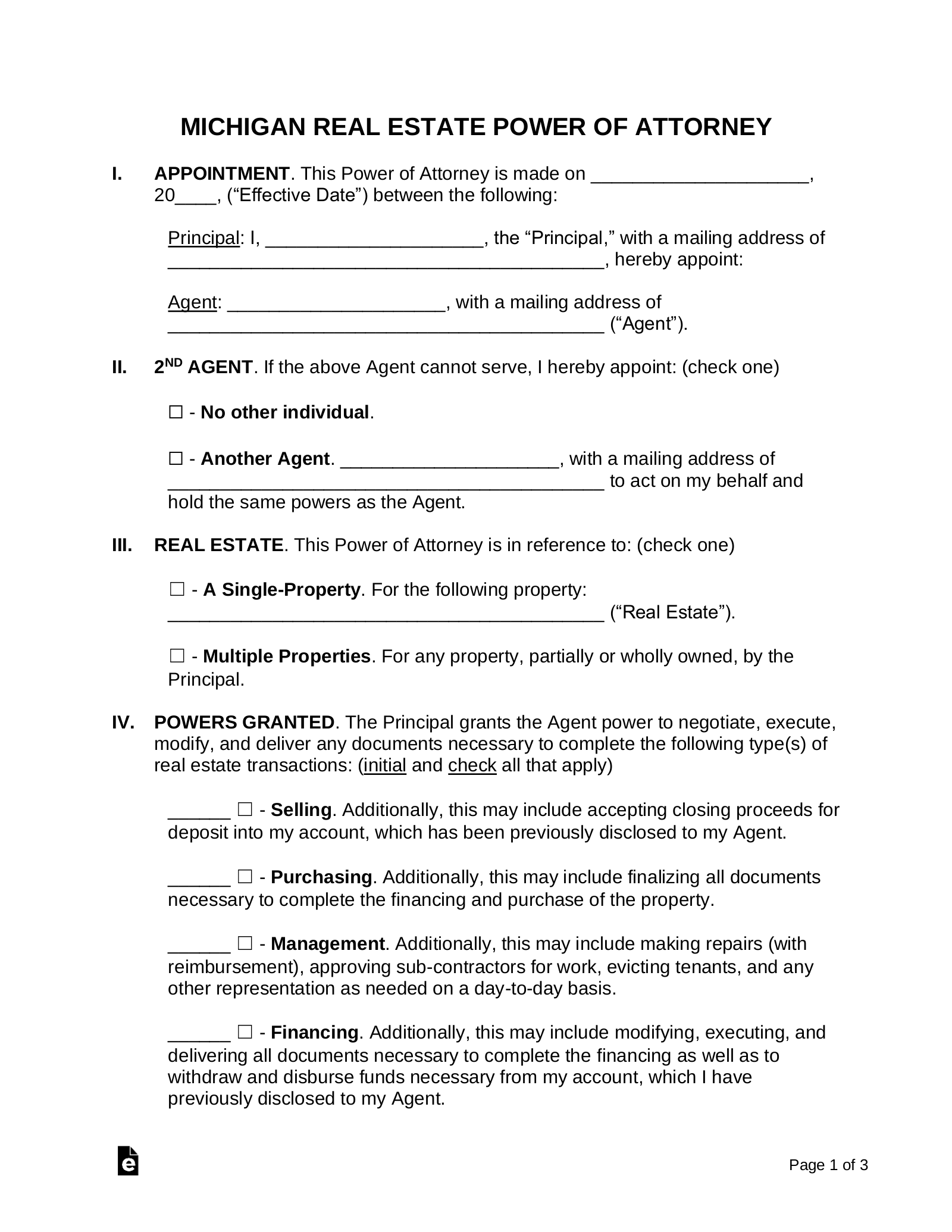
Agent
Step 1 – Select Real Estate Powers
- A real estate power of attorney can be used to give powers for single or multiplereal estate transactions. It is also very useful when needing someone to manage your property. This could include signing lease agreements, buying or selling property, evicting tenants, etc. As an example, a property owner could hire a property management company to re...
Step 2 – Setting The Terms
- Typically, if your intention is for a single transaction, you would select a start and end date. If the agent is managing the premises, then the principal would maybe want the term to be indefinite. In addition, if the principal is seeking to have the agent keep their role if the principal should be incapacitated or not able to use cognitive functions, they can select the form to be “durable”.
Step 3 – Signing The Poa
- Once complete, your real estate power of attorney must be signed by both yourself and the agent. It depends on the signing requirements in the State.
I. Date
- (1) Calendar Date Of Agreement.Furnish the effective date when this document is set to be an active representation of the Principal’s wishes.
II. Appointment
- (2) Principal Name.The Principal is the Party with the legal right to control, buy, or sell the property this designation concerns. His or her legal name must be supplied in the appropriate area of the second article. (3) Principal Address. Continue identifying the Principal making this appointment by documenting his or her official mailing address. (4) Agent Name.The Agent that the Principal …
III. 2nd Agent
- Select Item 6 Or Select Item 7 (6) No Alternate Agent.In some cases, the Principal may wish to ensure that his or her intent with property is carried out. If the Agent is unable or unwilling to act on the Principal’s behalf an Alternate Agent may step in but only if this Party is named in this document. This paperwork will not require that an Alternate Agent is named and will enable the …
IV. Real Estate
- (9) Real Property.Produce the information needed to identify the real property that the Agent will be able to work with utilizing the Principal’s authority. To do so, the physical address (and ideally the legal description) of the property should be presented in the second article.
v. Powers Appointed
- Select Any Combination Of Item 10, Item 11, Item 12, And Item 13 (10) Sale Of Real Estate.The decisions or the actions that the Principal expects and intends for the Agent to be able to engage in with the same authority the Principal exerts should be clearly discussed. Therefore a review of the list provided should be made. If the Agent should be able to use the Principal’s authority to c…
VI. Term
- Select Item 14 Or Select Item 15 Or Select Item 16 (14) End Date.The time period when this agreement begins will (unless otherwise indicated) be considered its signature date. However, the time or manner that causes its termination should be established. If the Principal only wants the Agent to access and utilize his or her authority until a specific date, the first statement in Article …
Popular Posts:
- 1. how to file for divorce in florida without an attorney
- 2. how to get power of attorney in nj
- 3. how to research an attorney track record
- 4. how to choose an attorney
- 5. how to fight attorney fees
- 6. which excerpt from part one of trifles most develops the motives of the county attorney?
- 7. how to find a pro bono attorney
- 8. what type of software can your parents use to create a will without visiting an attorney?
- 9. who is my district attorney
- 10. how to get power of attorney for parent with dementia